
I love lists. I love completing lists. And for that reason, I’m not always a fan of repeating something.
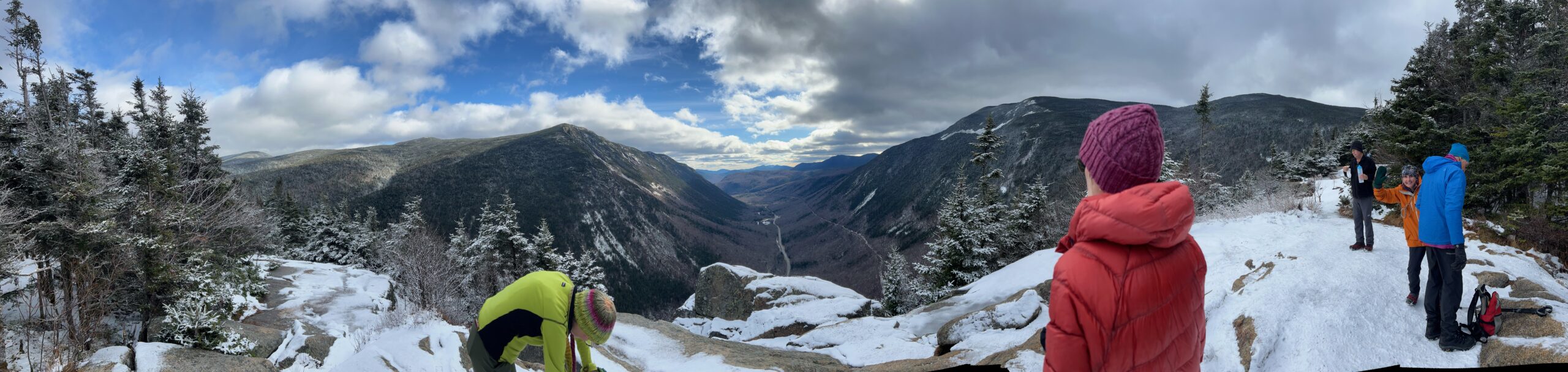
I’m on a quest to complete both the 48 4000-footers in New Hampshire (30 so far), as well as the 52 With a View (10 so far). The latter is a list curated by Ken MacGray of 52 peaks in NH below 4000 feet but with good views. Mt. Willard is on the list and one of the easiest to complete. From the trailhead at the train depot at Crawford Notch, it’s 1.6 miles with an elevation gain of 895 feet. The trail is wide and well-maintained, and the view from the ledges at the top is stunning. You can see down through Crawford Notch with the ribbon of highway running through it. If you catch it right, you can see the Conway Scenic Railroad train approaching along the side of the ridge at the right.
I have hiked this mountain several times over the years. I did it when I stayed at the Appalachian Mountain Club‘s Highland Center next to the train depot. I stayed there a few times to work on my dissertation, and the hike up Willard was a welcome distraction. I think maybe I did it with my family at least once and maybe with another group of friends. I’ve done it in summer, fall, and winter. And even though I don’t like repetition because of some twisted logic that tells me I should use my energy to complete something on the list, I still love revisiting certain places. I even feel nostalgic about them as I recall past trips to the same spot.
Repetition is one of the keys to creating nostalgic feelings. Familiarity creates a sense of pastness. Repetition helps solidify memories in our minds. Nostalgia depends on memories (real or constructed) of the past.
In music, the repetition of melodic gestures, chord progressions, rhythmic profiles, and vocal and instrumental timbres contribute to a musical style, but over time, they come to suggest a stable sonic identity which can then be used to invoke the past. For instance, early hillbilly music incorporated the sounds of acoustic instruments such as the banjo and fiddle. As country music has aged and reshaped its sound over and over, the use of those instruments has waxed and waned. But when they appear, it sounds like the music is reaching back through time. The result is a sense of looping through time rather than progressing. Mark Fisher (2014) depicts this as a new failure of popular music (new, at least, since the 1980s), but it seems like a baked-in and necessary feature of country music. It’s familiar. It’s the past. It’s not about completing some list or experiencing new things. It’s comforting. It’s nostalgic. It’s not a reference to a style; it is the style.
Fisher, Mark. Ghosts of My Life: Writings on Depression, Hauntology, and Lost Futures. Winchester, UK: Zero Books, 2014.